


The Social Welfare Study Program of the Faculty of Social and Political Sciences (FISIP), Universitas Sumatera Utara (USU), once again held a Focus Group Discussion (FGD) on the OBE Kampus Berdampak Curriculum. Previously, in 2017, the study program implemented the Indonesian National Qualifications Framework (KKNI) Curriculum, which was subsequently replaced in 2021 by the Outcome-Based Education (OBE)–Independent Learning–Independent Campus (MBKM) Curriculum.
In 2026, another curriculum FGD was conducted to revise the OBE Kampus Berdampak Curriculum in line with developments in education, with a focus on strengthening the downstream implementation of learning through collaboration with the business and industrial sectors, in accordance with the mandate of Regulation of the Minister of Higher Education, Science, and Technology of the Republic of Indonesia Number 10 of 2026 concerning Amendments to Regulation of the Minister of Higher Education, Science, and Technology Number 39 of 2025 concerning Quality Assurance in Higher Education.
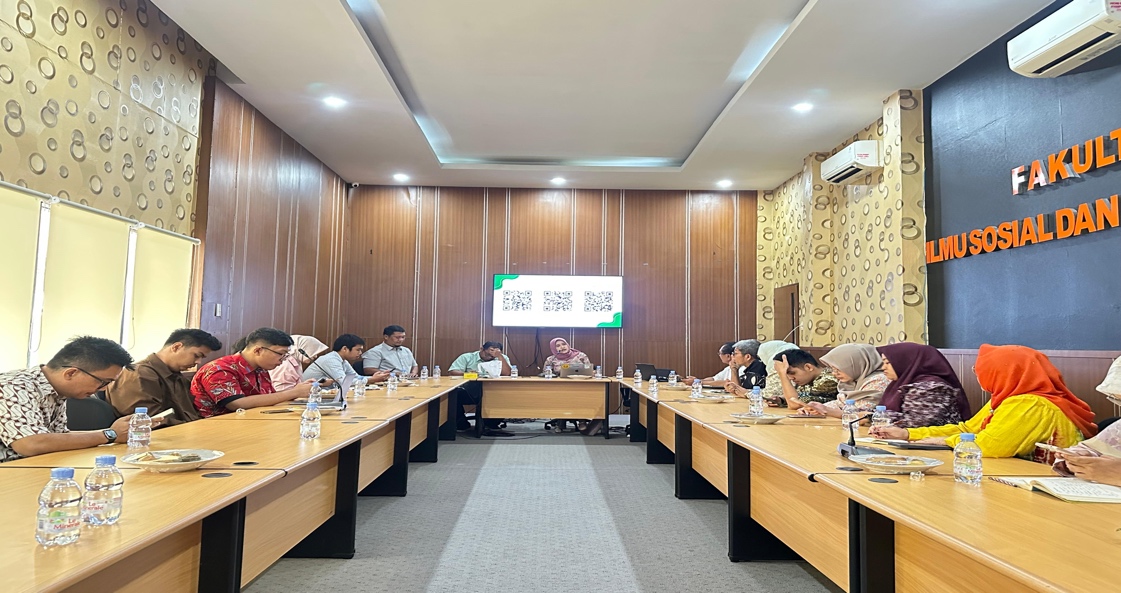
The event was held in the FISIP USU Leadership Meeting Room. Representatives of several institutions participated in the FGD, including the Social Affairs Office of North Sumatra Province, the Medan Social Affairs Office, the Medan Class I Probation and Parole Office (BAPAS), Sentra Bahagia under the Ministry of Social Affairs of the Republic of Indonesia, the Regional Technical Implementation Unit (UPTD) for Social Services for Children and Adolescents (PSAR) Tanjung Morawa, the Regional Technical Implementation Unit (UPTD) for Social Services for Toddlers in Medan, and the NGO Lembaga Fokus.
The FGD was opened by the Vice Dean for Academic Affairs, Student Affairs, and Alumni, Dr. Agus Suiadi, S.Sos., M.Si. The discussion was moderated by Randa Putra Kasea Sinaga, S.Sos., M.Kesos., under the guidance of the Head of the Social Welfare Study Program, Fajar Utama Ritonga, S.Sos., M.Kesos., and the Secretary of the Social Welfare Study Program, Mia Aulina Lubis, S.Sos., M.Kesos. The discussion took place in a constructive atmosphere and was attended by students, alumni, graduate users, lecturers, and education staff of FISIP USU.
Based on the results of the FGD held in the FISIP USU Leadership Meeting Room and the questionnaire distributed through Google Forms, input was gathered from stakeholders of the Social Welfare Study Program regarding the development of Graduate Profiles (GP) and Graduate Profile Learning Outcomes (CPL). The information collected through the FGD and Google Forms questionnaire was subsequently analyzed and aligned with the Graduate Profiles recommended by the Indonesian Association of Social Welfare and Social Work Education (APKPSI).
This synchronization served as the basis for the study program to formulate several Graduate Profiles, namely: (1) Addiction Social Worker; (2) Social Welfare/Social Work Program Manager; (3) Social Welfare Development Facilitator for Vulnerable Groups; and (4) Social Welfare Researcher.
The curriculum also incorporates the Sustainable Development Goals (SDGs) to support Key Performance Indicator (IKU) 12, as reflected in the development of Semester Learning Plans (RPS) for each course. Of the 17 SDGs, the Social Welfare Study Program’s curriculum focuses on SDG 1, SDG 2, SDG 3, SDG 4, and SDG 17.
The revision of the Social Welfare Study Program’s OBE Kampus Berdampak Curriculum is expected to respond to developments and emerging needs in higher education while strengthening the relevance of learning outcomes to societal needs and the professional field.