


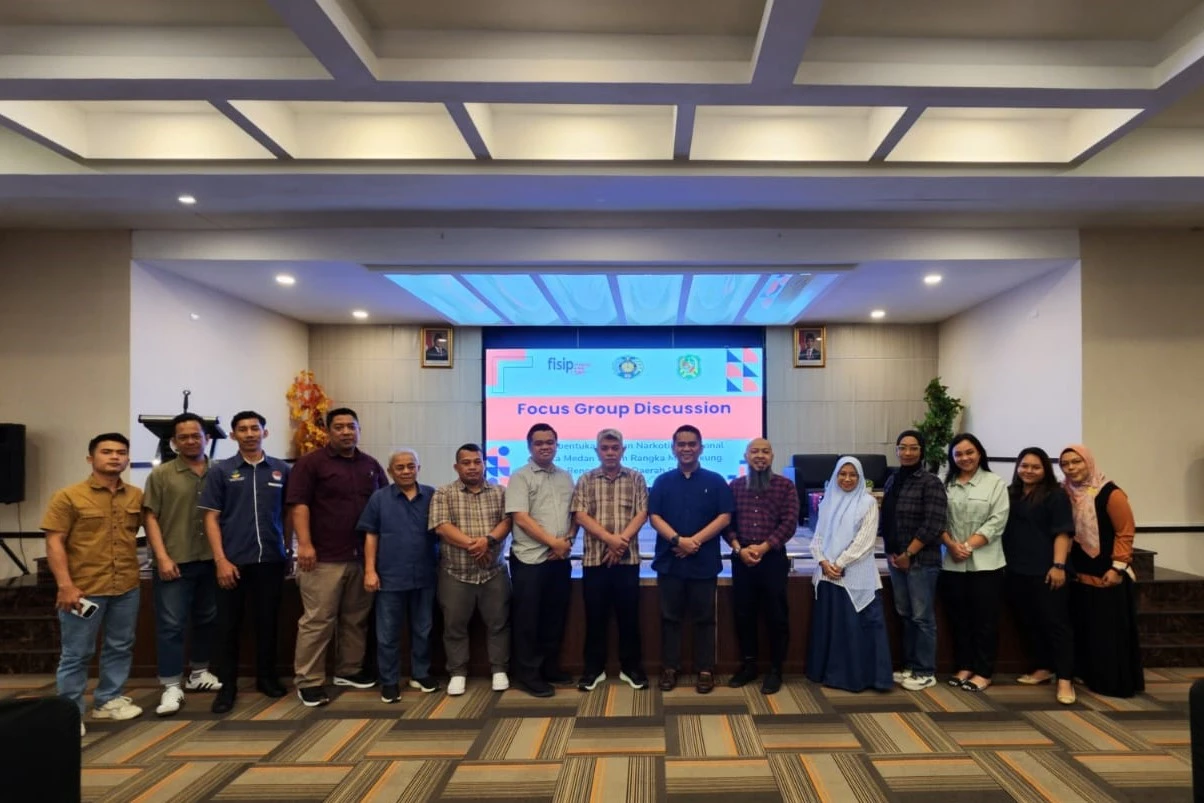
The Faculty of Social and Political Sciences, Universitas Sumatera Utara (FISIP USU), hosted the Civil Society Coalition's regular meeting, which focused on strengthening community participation in the application of restorative justice in narcotics cases handled by the police in Medan City and surrounding areas.
This initiative was a collaboration between the Indonesian Association of Addiction Counselors (IKAI) North Sumatra Chapter, Karisma Foundation, Galatea Foundation, and the Social Welfare Study Program of FISIP USU, with support from the Elton John AIDS Foundation. Eighteen civil society organizations, including LBH Medan, PUSAKA Indonesia, Medan Plus Foundation, and Rumah Harapan Sehat Foundation, attended the meeting at the FISIP USU Auditorium. The event aimed to encourage a more inclusive, recovery-oriented legal approach that actively involves civil society.
The forum featured open discussions, presentations, and Focus Group Discussions (FGD). Key topics included strengthening the Coalition’s organizational structure, improving the capacity for documenting cases of restorative justice implementation by the police, and developing long-term strategies for collaboration and advocacy. One FGD session also discussed the initiative to establish the Medan City National Narcotics Board (BNN) in partnership with the Medan City Regional Research Agency (BRIDA) and FISIP USU.
Through this activity, participants agreed on the importance of building a shared commitment to promote restorative justice practices that go beyond formal legal frameworks and emphasize social justice. This approach is considered more effective in restoring relationships between offenders, victims, and communities, while also reducing the recurrence of minor criminal acts related to narcotics abuse.
The collaborative steps resulting from this meeting are expected to serve as a starting point for more potent synergy between civil society and law enforcement, leading to a justice system that is fairer, more humane, and relevant to the needs of local communities.