


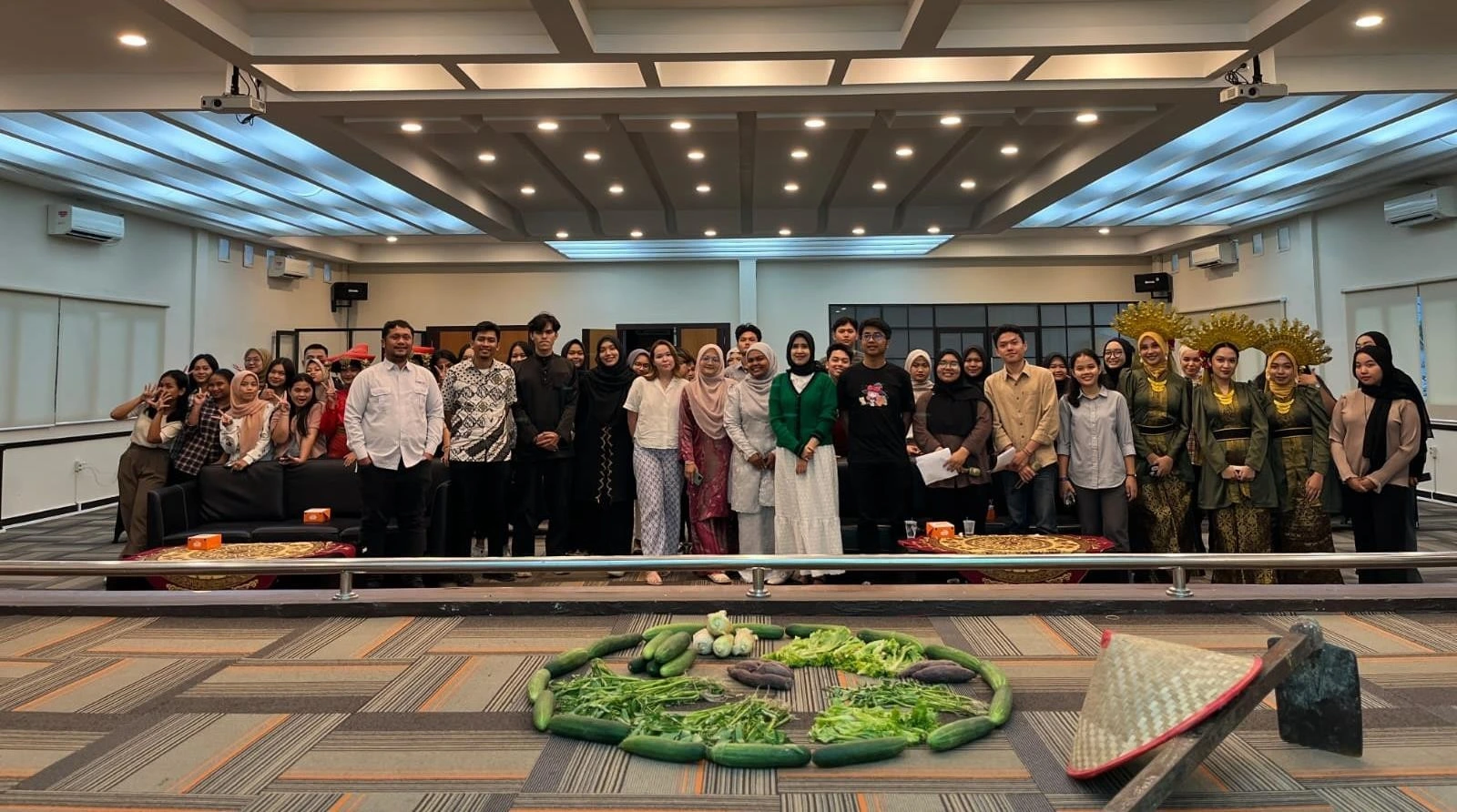
The Faculty of Social and Political Sciences (FISIP) of Universitas Sumatera Utara (USU) organized the 2024 International Summer Course entitled “The 3rd Agrarian Politics, Food Sovereignty, and Peasants’ Rights” on October 21–28, 2024. This activity was part of Universitas Sumatera Utara’s efforts to strengthen academic internationalization.
The program was implemented by the Center for the Study of Peasants’ Human Rights (PUSKAHAP) of FISIP USU and was attended by participants from various countries, including Malaysia, Pakistan, India, the Philippines, Australia, Kazakhstan, Sudan, Ghana, Egypt, and Yemen, as well as students from several universities in Indonesia. The program chair, Randa Putra Kasea Sinaga, S.Sos., M.Kesos. (Lecturer of the Social Welfare Study Program of FISIP USU), explained that this summer course was designed to bring together academic studies and field realities. “Through this program, participants not only gain a theoretical understanding of agrarian politics and food sovereignty, but also directly observe the practices and dynamics faced by farming communities in North Sumatra,” he stated.
The series of summer course activities consisted of international lectures and field visits. During the lecture sessions, participants received materials from international academics, such as Prof. Peter M. Rosset (ECOSUR Advanced Studies Institute, Mexico) and Prof. Dr. Saturnino M. Borras Jr. (ISS Erasmus University), who discussed agrarian issues, food systems, and academic activism.
Meanwhile, the field visit activities were carried out in several areas, including Asahan Regency, Simalungun Regency, Parapat, and Samosir Island (Lake Toba). Participants conducted field observations, discussions with farming communities, and introductions to the culture and local wisdom of North Sumatra. The Dean of FISIP USU (Dr. Hatta Ridho, S.Sos., MSP) considered this activity strategic in expanding the faculty’s international networks, particularly in developing the Faculty of Social and Political Sciences’ networks at the international level within the ASEAN and Asia regions.
“This International Summer Course serves as a cross-national learning platform as well as a means to introduce the academic excellence of FISIP USU to the global community,” he said.
During the eight days of implementation, the activities were conducted in a blended format, combining online and offline lectures as well as field activities. The program concluded with a closing ceremony and a city tour in Medan City. Through this activity, FISIP USU targeted several outputs, including increased participation of international students, the involvement of foreign lecturers in the tridharma of higher education, the establishment of cross-national education and research cooperation, and encouragement of joint scientific publications between USU academics and international partners.