


.webp)
The Indonesian Agency for International Development (Indonesian AID), or Lembaga Dana Kerja Sama Pembangunan Internasional (LDKPI), in collaboration with the Faculty of Social and Political Sciences, Universitas Sumatera Utara (FISIP USU), held a talk show titled “Indonesian AID: Strengthening the Economy, Deepening Diplomacy” on Tuesday, September 2, 2025. Conducted online via Zoom and streamed live on USU Media’s YouTube channel, the event aimed to open public and academic dialogue on Indonesia’s role as an international grantor. In his opening remarks, the Dean of FISIP USU, Dr. Hatta Ridho, stated that students should critically assess whether Indonesia is currently “ready” to provide international grants, not only in terms of budget but also in impact, transparency, and the agility of diplomatic action. He emphasized that grant policies should not serve merely as diplomatic imagery but must deliver tangible benefits on the ground.
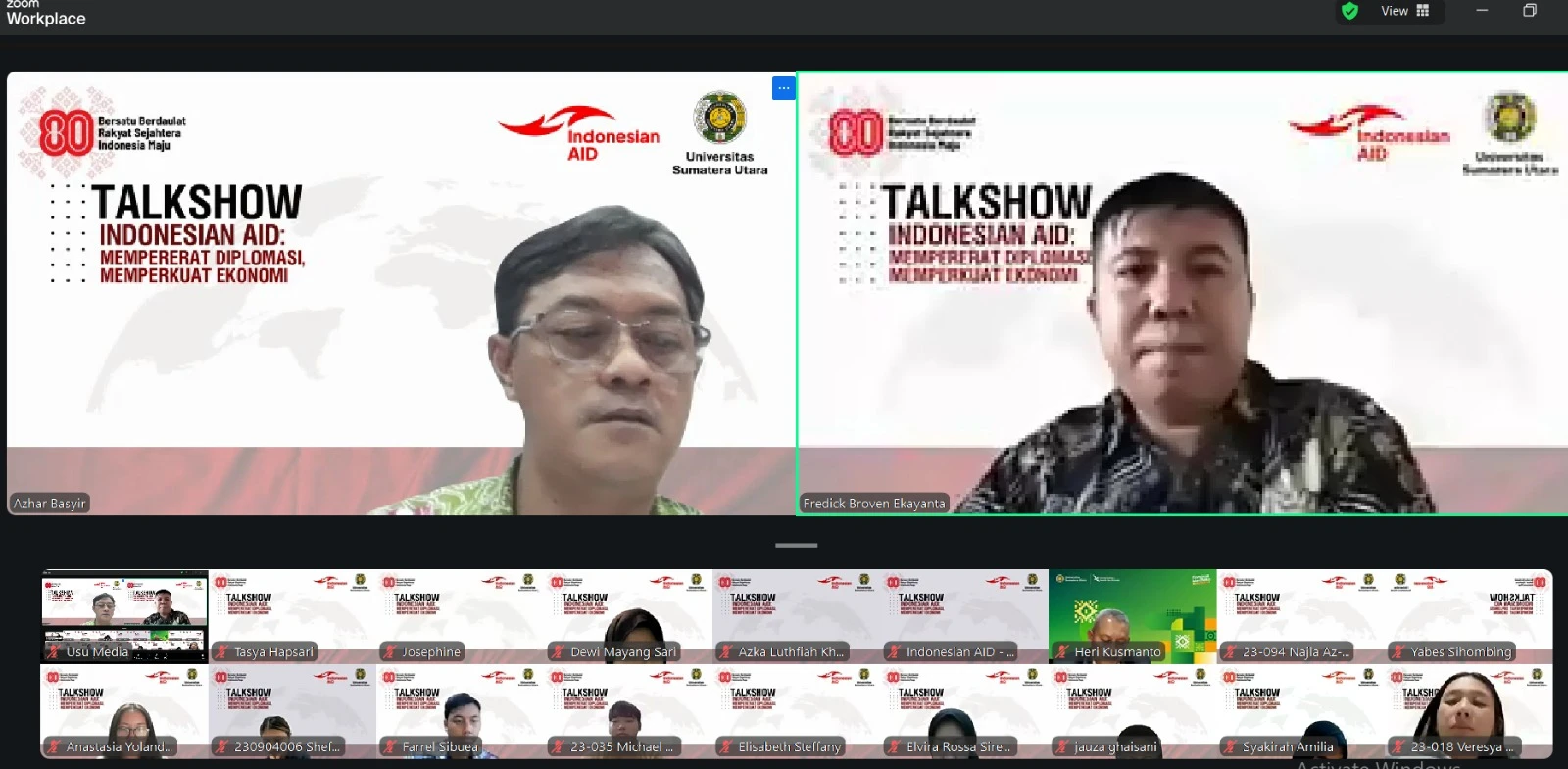
Azhar Basyir, Head of Legal and Institutional Relations Division at Indonesian AID, affirmed that Indonesia’s humanitarian diplomacy has deep roots even before the establishment of the formal institution “In 1946, just a year after independence, Indonesia sent 300 thousand tons of rice to India… However, those aid efforts were sporadic and uncoordinated. Therefore, in 2019, Indonesian AID was established to ensure integration and strategic implementation." He also explained that aid is not always in the form of money but can include goods and physical activities, such as domestically produced vaccines and biscuits, school renovations, and leadership training programs in the Pacific and Africa. Furthermore, he highlighted that “It is important to note that these grant funds do not burden the annual state budget (APBN). The grants come from the investment returns of the endowment fund we manage.”
Prof. Drs. Heri Kusmanto, M.A., Ph.D., Secretary of the Doctoral Program in Development Studies, FISIP USU, emphasized that foreign grants are not mere charity but political and economic instruments that also bring benefits to Indonesia. He warned that lengthy bureaucracy could hinder tangible outcomes: “The main challenge lies in the lengthy bureaucracy, such as the need for approval from four different ministers. As a result, aid delivery can be delayed and lose effectiveness. Therefore, the mechanism needs simplification.” Public data support that the Indonesian AID has made significant achievements since its establishment. According to Kompas and Detik reports, by September 2024, Indonesian AID had distributed grants totaling Rp 523.56 billion to 97 countries and foreign institutions through various programs, ranging from health and humanitarian initiatives to capacity-building and training.
Furthermore, Prof. Heri stressed that academic evaluation is crucial to ensure that grant benefits are accurately targeted and have real impacts both on recipients and on Indonesia as the donor. This view aligned with Azhar’s statement that humanitarian diplomacy yields reciprocal benefits, for instance, Indonesia’s oxygen aid to India during the pandemic and India’s subsequent response during the Delta wave. The talk show discussion also addressed administrative mechanisms as key determinants of international response speed. During the Q&A session, students actively asked about how evaluation systems work, how aid implementation avoids delays due to multiple approvals, and how academics or researchers are involved in impact assessment. Drawing from transcript excerpts and public data, the overall narrative showed that Indonesia indeed possesses both the capacity and goodwill to act as an international grantor, not merely as a symbol of diplomacy, but with concrete evidence of effectiveness. However, to be truly deserving in all aspects, Indonesia must focus on effectiveness, transparency, and bureaucratic simplification to seize international momentum.
As a token of appreciation for the students’ active participation, the event concluded with the presentation of souvenirs to participants who engaged in the discussion and dialogue. These souvenirs symbolized the organizers’ recognition of the value of young people’s input and perspectives.
Writer: Tabitha R. Simbolon