


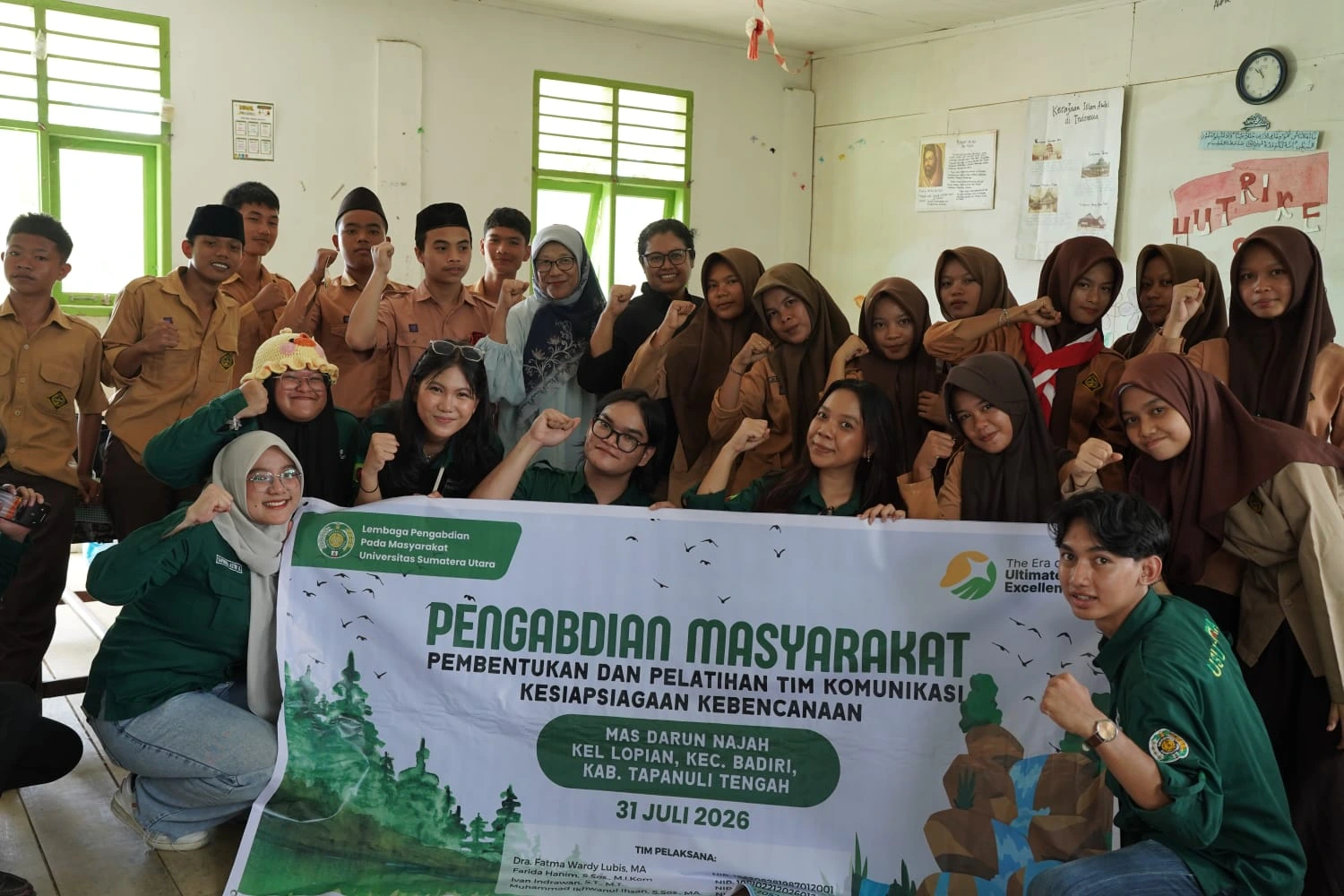
The Community Service Team from the Faculty of Social and Political Sciences (FISIP) of Universitas Sumatera Utara (USU) held an activity entitled “Establishment and Training of a Disaster Preparedness Communication Team” at Madrasah Aliyah Swasta (MAS) Darun Najah, Lopian Village, Badiri District, Central Tapanuli Regency, on Friday (July 31, 2026). This program, based on expertise in social sciences and communication, reflects the concern of FISIP USU academics regarding the vulnerability of the coastal areas of Central Tapanuli to natural disasters. Lopian Village has a history of vulnerability to floods and landslides, which may disrupt residents’ daily activities and damage distribution routes for essential goods.
The community service activity was led by Dra. Fatma Wardy Lubis, M.A., as Head of the Community Service Team, with FISIP USU lecturers Farida Hanim, S.Sos., M.I.Kom., Ivan Indrawan, S.T., M.T., and Muhammad Ikhwanul Ihsan, S.Sos., M.A., supported by eight students from the Communication Science Study Program at FISIP USU. The academic team aimed to provide direct education on the importance of information management during crises. Communication is considered a vital element in disaster risk reduction, an aspect that has often received limited attention and is frequently regarded as less important. In fact, disaster management depends heavily on effective information and coordination throughout all stages, from the pre-disaster or mitigation stage and emergency response to the post-disaster reconstruction and rehabilitation process.
Head of the FISIP USU Community Service Team, Dra. Fatma Wardy Lubis, M.A., emphasized the importance of changing the way communities perceive crises. “Disasters are not only about natural events but also about how communities receive, understand, and communicate information. Therefore, disaster-related issues are important topics that must continue to be communicated and taught to the public,” she stated. She added that during emergencies, fast, accurate, and reliable information can reduce panic and help communities make appropriate decisions, although many areas still lack structured disaster communication systems.
To address these challenges, FISIP USU applied a comprehensive communication science approach encompassing intrapersonal, interpersonal, group, organizational, public, mass, and intercultural communication. This approach aims to improve the knowledge of communities and disaster survivors regarding different types of disasters and appropriate disaster response measures. In particular, the program engaged young people and students at MAS Darun Najah, given their strategic position and close connection to developments in digital media. Young people are expected to serve as a bridge between official information and the wider community, while also becoming agents of change who produce, disseminate, and clarify information to prevent the spread of misinformation and panic.
Through a series of training sessions, discussions, interactive face-to-face activities, disaster simulations, and the development of digital educational content, FISIP USU officially established a Disaster Preparedness Communication Team in Lopian Village. The establishment of this young volunteer team is expected to create a trusted source of information at the local level, improve community disaster literacy, and strengthen a community-based risk communication system. This initiative demonstrates FISIP USU’s commitment to providing research-based academic contributions to educate communities and enhance their preparedness for potential disasters, thereby helping reduce the risk of casualties and property losses in the future.
This community service initiative also supports the Sustainable Development Goals (SDGs), particularly SDG 11: Sustainable Cities and Communities, through efforts to strengthen community resilience and preparedness in the face of disasters, as well as SDG 13: Climate Action by increasing community capacity to respond to environmental risks and climate-related hazards.