


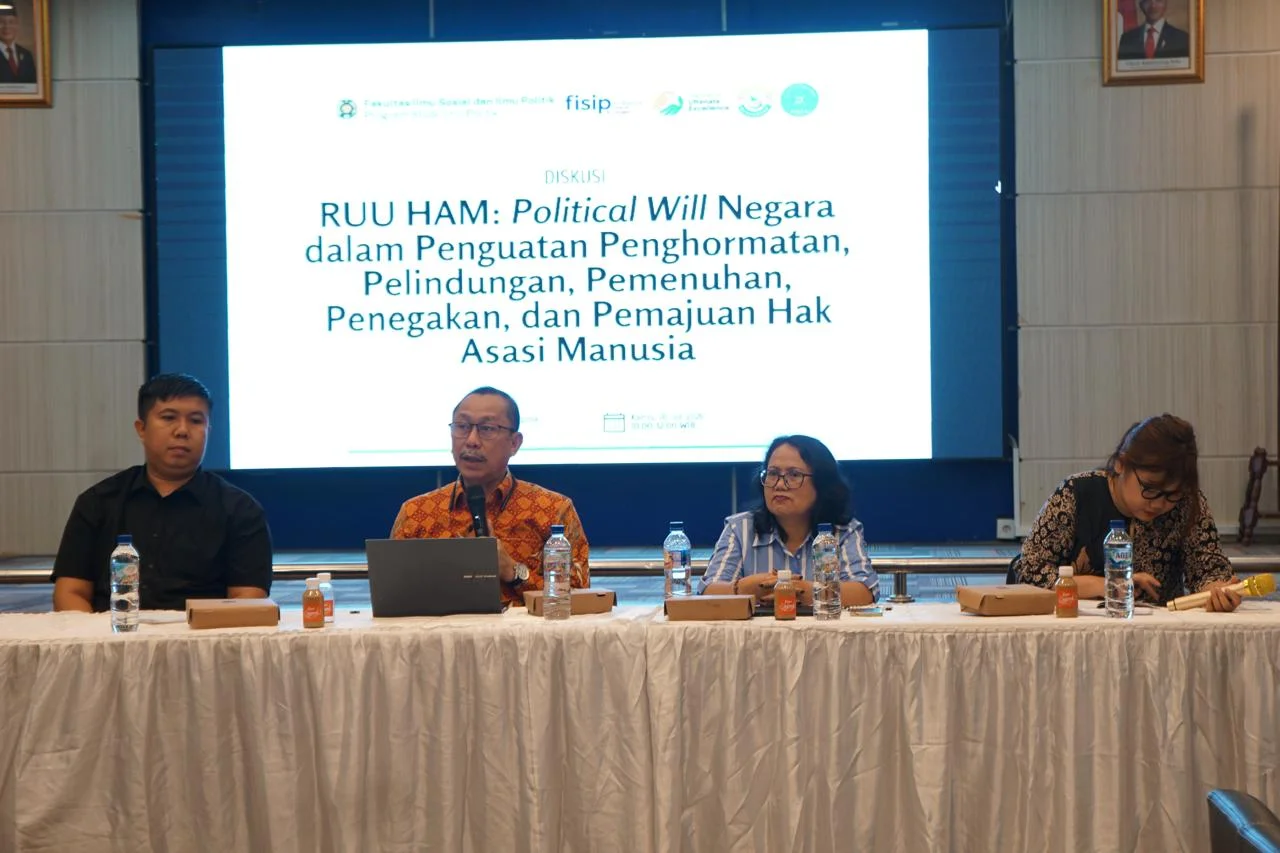
The Faculty of Social and Political Sciences (FISIP) of Universitas Sumatera Utara (USU) held a public discussion titled "The Human Rights Bill: The State's Political Will in Strengthening P5HAM?" at the FISIP USU Hall on Thursday, July 30, 2026. This academic forum was organized as a space for critical examination of the direction of legal reform and human rights governance in Indonesia. The event featured three expert speakers from academia, legal practice, and civil society activism, namely Ahmad Taufan Damanik, Chair of the National Human Rights Commission (Komnas HAM) for the 2017–2022 period, a lecturer at FISIP USU, and one of the drafting team members of the Human Rights Bill; Fredick Broven Ekayanta, a Political Science lecturer at FISIP USU; and Juniaty Aritonang, Director of Legal Aid and Advocacy of North Sumatra (Bakumsu).
In his presentation, Ahmad Taufan Damanik emphasized that the revision of Law Number 39 of 1999 concerning Human Rights has become an urgent necessity. The dynamics of society and the development of current human rights issues are considered to have become far more complex, requiring a national legal framework that is more adaptive, responsive, and relevant to contemporary challenges. Taufan explained that the Human Rights Bill was specifically designed to reinforce the state's obligations to respect, protect, fulfill, uphold, and promote human rights (P5HAM). Furthermore, the latest draft regulation also begins to address various contemporary issues that have not been optimally accommodated in the previous law, such as special protection for vulnerable groups, security guarantees for human rights defenders, the fulfillment of the right to a clean and healthy environment, and a framework for corporate responsibility in respecting human rights.
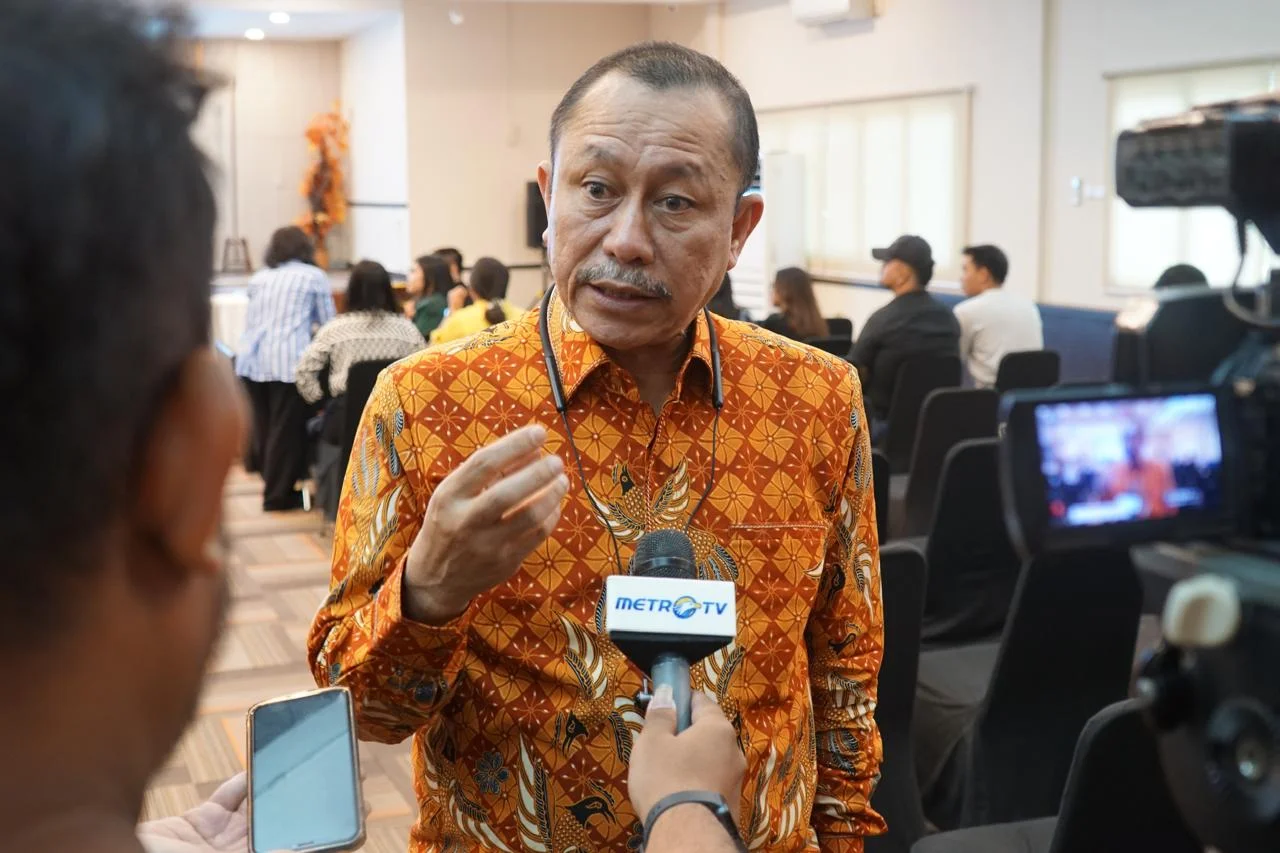
On the same occasion, Taufan also clarified the perception that the draft regulation would expand or overlap the authority of certain ministries or government institutions. He emphasized that the Human Rights Bill instead serves to clarify the boundaries of the division of state responsibilities so that the fulfillment of citizens' rights can be carried out more measurably. Meanwhile, the position of Komnas HAM remains maintained as an independent institution that performs a supervisory function within a system of checks and balances. The involvement of the FISIP USU academic community in this discussion was also considered a concrete manifestation of the meaningful participation space that continues to be opened throughout the process of drafting the public policy.
From a political theory perspective, Political Science lecturer at FISIP USU, Fredick Broven Ekayanta, stated that this legal reform is not merely a form of technical legislative reform, but a crucial momentum for encouraging the transformation of relations between the state and civil society. Referring to Benedict Anderson's concept of old state, new society, Fredick encouraged Indonesia to move forward toward a new state, new society order. This new order reflects a state that is far more responsive to the aspirations and developments of its citizens, while being balanced by an increasingly critical and empowered society. According to him, the presence of a strong state in carrying out its legal protection functions must go hand in hand with the presence of strong people in overseeing the exercise of power, in order to maintain the sustainability of a healthy democracy in Indonesia.
The organization of this public discussion reinforces FISIP USU's commitment to continuing to position itself as an academic forum that is responsive to various strategic national issues. Through collaboration and the exchange of ideas between academics and practitioners, FISIP USU continues to strive to contribute research- and evidence-based perspectives to the formulation of public policies that are just, democratic, and fully oriented toward respect for human rights.